You passed the gates. AI can find you. You've clarified your entity: AI understands what you do. But when a buyer asks which firm they should hire, AI cites your competitor with confidence and mentions you with a hedge. Or doesn't mention you at all.
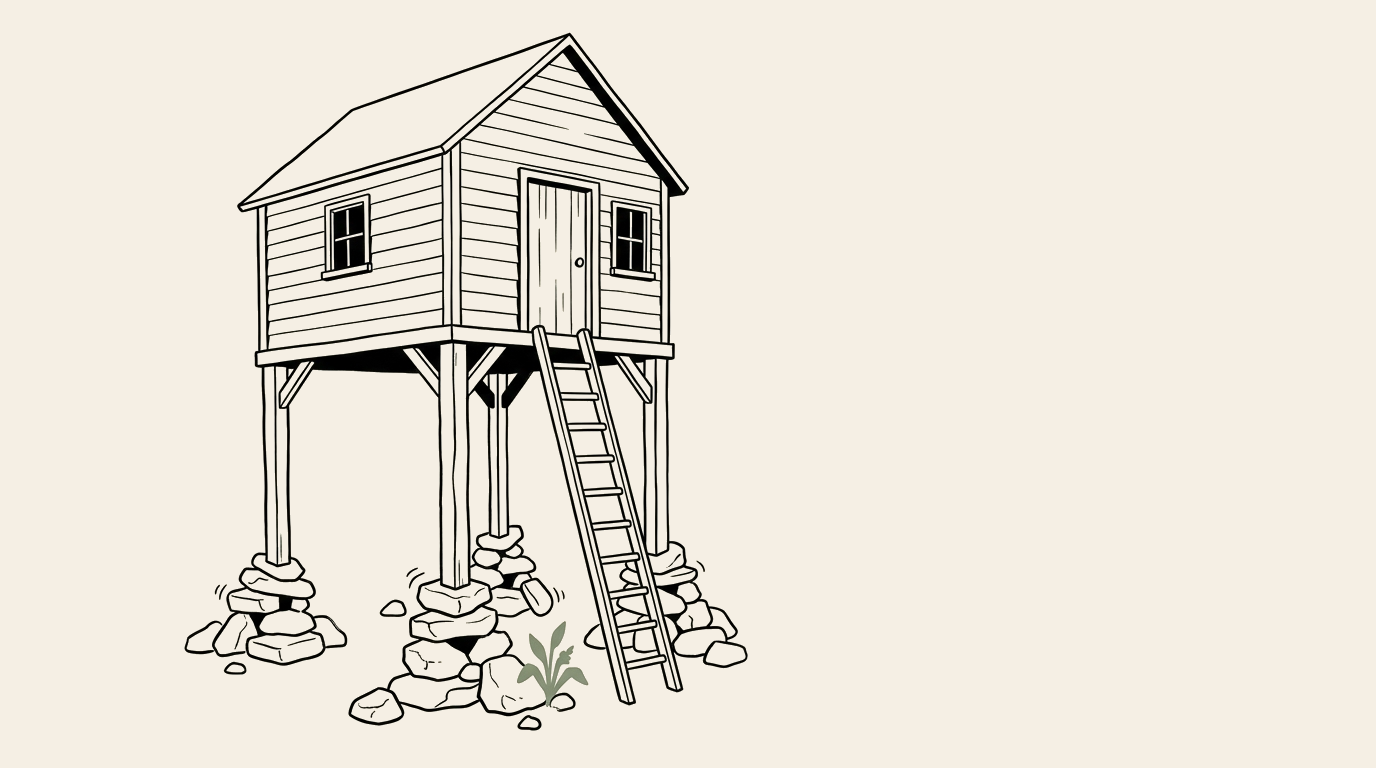
Trust isn't a switch you flip. It accumulates, the way brand authority does, across every source that's ever mentioned you, including the ones you've forgotten exist. The question isn't whether you can fix it. The question is whether you know where the damage is.
The Signal Check That Changed Everything
A VP of Marketing at a mid-market B2B firm runs his company through a Signal Check. He's expecting to see roughly what the website says: a specialized consultancy with deep expertise in a specific vertical, 27 years of client results, a leadership team with industry pedigree.
What he sees instead is a stranger's description of his company.
One AI platform calls them "a general consulting firm." Another mentions a product they discontinued four years ago. A third gets the founder's name right but attributes a completely different specialization to the firm. The fourth doesn't mention them at all.
His first instinct is the one everybody has: find the wrong fact. Fix it. Move on.
He traces the discontinued product mention to a G2 profile nobody's updated since 2022. Easy enough. He removes it. Done.
Except now G2 says they offer six products, but their Clutch profile still says seven. Their LinkedIn company page says "strategic advisory," their website says "management consulting," and an old Inc. magazine feature from 2019 calls them a "technology consultancy." The founder's former firm still lists him as a partner on their alumni page with a completely different description of his expertise.
He didn't have one wrong fact. He had dozens of small contradictions scattered across two decades of digital presence. And every one of them was feeding AI a slightly different story about who his company is.
This is the trust layer. There's not one dramatic failure, but death by a thousand papercuts.
Trust Accumulates
Here's the thing nobody in B2B marketing wants to hear: you don't build trust with AI the way you build a campaign. You can't brief it, launch it, and measure it in a quarter. Trust accumulates. Or it erodes. Slowly, across every source that mentions your business, including sources you didn't create and have never seen.
Think about how brand authority works in the real world. A company crafts its positioning with intention: the messaging, the visual identity, the value proposition. But the actual brand, the thing that lives in the market's mind, isn't what the company says about itself. It's what the audience believes after absorbing everything they've encountered.
The intentional messaging is there. But so are the Glassdoor reviews, the offhand mention in a trade publication, the conference panel where the CEO said something slightly different from what the website says.
In the second article in this series outlining the UNDERSTAND layer, we talked throughout about the precision AI training requires. We also diagrammed the way AI searches through fan out queries. An AI agent absorbs everything simultaneously and has no ability to weigh your intentions.
As it's working, AI can see that the G2 profile was added 4 years ago, but it doesn't know whether that information is still valid. It can see that your CEO was quoted in Inc. magazine, but can't tell that the quote was taken out of context. It treats every source as a data point until it can synthesize the information and builds a final score that is its understanding from the aggregate.
When those data points align, when your website, your LinkedIn, your press coverage, your directory listings, your leadership bios, and your client case studies all tell the same story, AI cites you with confidence. When they contradict each other, even in small ways, AI hedges. "Reportedly offers." "Appears to specialize in." "May provide services related to."
That hedging language isn't a bug in AI. It's AI accurately reflecting the state of your digital footprint: inconsistent.
What AI Is Synthesizing About You
If trust accumulates from everything AI touches, then every page, profile, and mention that describes your business is a data point. Some are current. Some are years out of date. AI weighs all of them, but not in the same way that traditional SEO does.
| Signal | SEO Authority | AI Trust |
|---|---|---|
| Primary driver | Backlinks from many domains | Consistent claims across independent authoritative sources |
| What counts | Quantity of links | Specificity of corroboration |
| Entity foundation | Domain strength | Entity consistency across all sources |
| Decay rate | Slow (backlinks persist) | Fast (AI retrains; outdated sources lose weight) |
| Volume play | Works (more links = stronger) | Fails (100 vague mentions < 3 specific corroborating ones) |
The last row is the critical insight. In SEO, spray-and-pray content strategy worked (at least for a while) because Google's algorithm rewards cumulative signal. In AI, spray-and-pray fails because AI is looking for consensus, not noise.
Here are just some of the places AI could surface information about your business. They're listed in order from easy to change to difficult, to help you prioritize making not just that one fix that jumped out to the VP. You need to make as many of the little fixes as you can, across as many surfaces as you can, to improve the accuracy and consistency of your brand reputation.
Your website
Your website is the single largest signal. Kevin Indig's 2026 research found that 94.7% of AI citations reference corporate websites. What you say on your about page, your service pages, your case studies, your leadership bios, and your blog is the dominant input. But it's not the only one.
Your structured data layer is also on your website, and it matters more than most B2B firms realize. It's you telling AI, in its own language, what your entity is: your name, your category, your location, your services. MarkeStac's 2026 analysis found that pages with valid schema markup are 2-4x more likely to appear in Google's AI Overviews, and pages with FAQPage schema specifically achieve up to 2.7x higher citation rates. Without structured data, AI has to guess what it's looking at. With it, you're handing AI a verified label for every entity on your site.
Your owned profiles and directories
Your LinkedIn company page, Google Business Profile, listings on G2, Clutch, and industry-specific directories. These are your claims about yourself, repeated across platforms you control or can update. When they're consistent with your website, they reinforce the signal. When they drift, they dilute it.
Third-party sources you can influence
Old press coverage that describes a version of your company from five years ago. Former employee profiles that still list your firm with outdated titles and descriptions. Archived partnership pages on other companies' websites. Event speaker bios from conferences you attended in 2019. Product listings on review sites that nobody's maintained.
A company that's been in business for 20 or 30 years has an enormous digital trail. Most of that trail was never intended to be permanent. But AI doesn't distinguish between "current" and "archived." It doesn't know that the 2019 conference bio is outdated. It just knows that one more source describes your company differently from the others. Many of these can be corrected if you know they exist. Most companies don't.
Sources you can't control, including your competitors
This next part is going to sound very familiar to anyone who has worked in SEO. When your competitor earns a confident citation from AI, that citation becomes training data. The model learns to associate your competitor with your category. The next query reinforces it. The next one solidifies it.
Jason Barnard calls this cascading confidence. Early citation authority compounds. Late entrants fight against feedback loops they didn't create. The model has already "decided" who the authorities are, and breaking that pattern requires exponentially more effort the longer you wait.
Digital Bloom's 2026 AI Citation Position and Revenue Report found that early movers in AI visibility reported a 527% AI traffic surge and 3x higher visibility compared to late adopters. Not because they had better content. Because each citation reinforced their authority, and each of your missed citations reinforced your absence.
The Corroboration Threshold
If that last bit sounded like a traditional SEO setup, here's where trust diverges from everything B2B marketers know about SEO.
AI trust operates on a completely different principle: corroboration. It doesn't care how many sources mention you. It cares whether each one of those essential facts it needs to describe your company is corroborated by another source. If independent, authoritative sources make the same claims about your business as you do, that data point becomes a quotable fact.
When two to three independent high-authority sources confirm the same description of your firm, something shifts. AI platforms move from "sometimes includes" to "reliably cites" you in their responses. That's the corroboration threshold: the point where AI's internal confidence in your entity crosses from uncertain to authoritative.
Rand Fishkin's SparkToro research quantified this across thousands of AI queries, and Metricus corroborated it across 73 million brand profiles. Brands above the corroboration threshold appeared in 55-97% of AI responses. Brands below it surfaced intermittently. The language shifts too: below the threshold, AI hedges with "claims to be" and "reportedly offers." Above it, AI asserts with "is" and includes you consistently.
This is why a hundred directory listings describing you as "a consulting firm" do nothing, while three well-placed industry publication mentions describing you as "a supply chain optimization firm for mid-market food manufacturers" change everything. AI is looking for consensus among sources it already trusts, not volume from sources it doesn't.
The Fan-Out Revisited: What AI Is Actually Checking
Remember the fan out queries AI uses to gather its information. AI isn't just using those on your website. They're checking everything: your site, your competitors' sites, industry publications, review platforms, LinkedIn profiles, press coverage, conference proceedings. Every source those sub-queries touch is a data point that either reinforces or undermines your entity.
A firm that's been online for 5 to 30 years has content scattered across hundreds of sources. Some of it is current. Some of it reflects a version of the company that no longer exists. Some of it was written by someone who never got the messaging quite right.
AI touches all of it. And when what it finds across those sources doesn't match what your website says, it doesn't pick a winner. It hedges.
This is why the VP who fixed one G2 listing wasn't done. AI wasn't looking at one source. It was synthesizing across dozens. And most of those sources were telling a slightly different story.
The Freshness Factor
There's one more variable that changes the equation: time.
Digital Bloom's 2026 research found that 76.4% of ChatGPT's top-cited pages were updated within the last 30 days. Content freshness within 30 days earns approximately 3.2x more AI citations than content older than 90 days. Pages without updates for three or more months are 3x more likely to lose their citation position. Sight AI's 2026 brand monitoring research confirmed the pattern at a broader scale: more than 70% of all pages cited by AI have been updated within the past 12 months.
This isn't AI preferring "new" content. It's AI using freshness as a proxy for authority. Content that someone maintains signals that someone considers it important. Content that sits untouched for a year signals abandonment.
And the compounding works here too. Fresh content gets cited. Citations reinforce authority. Authority earns more citations on the next query. Stale content gets skipped. Skipped content loses authority. Lost authority means fewer citations next cycle. The flywheel spins in both directions.
For a company with decades of history, this creates an uncomfortable math problem. You might have several hundred pages of content across your site and other platforms. Some of it was last touched in 2021. AI is weighing all of it, and the stale pages aren't just neutral. They're actively pulling down the freshness signal of the pages you do maintain.
The Find/Understand/Trust Framework
This is the third and final layer.
FIND asks: Can AI access your content? This is the technical layer where you control what AI agents can and cannot access through your CDN, your robots.txt file and the type of code you use to create your pages. This one's binary. You pass or you don't.
UNDERSTAND asks: Does AI comprehend what your business does? This is the content layer where you work on entity clarity, your fact-to-vibe ratio, and your semantic structure. There's an awful lot of grey area making sorting facts from vibes difficult.
TRUST asks: Can AI trust the information it found about your company enough to include you in its answer as a mention or citation? This is the reputation layer and the most expensive to ignore.
TRUST is where citations are born. And citations become revenue.
Seer Interactive's analysis of 3,119 search terms across 42 client organizations found that brands cited in AI Overviews saw 35% more organic clicks and 91% more paid clicks than when they weren't cited. Seer notes they can't prove the citation causes the lift (stronger brands may simply be more citable), but queries where you're cited consistently outperform queries where you're not.
A buyer who sees AI describe your firm with specific, confident, corroborated facts doesn't need to be convinced. They need to be contacted. A buyer who sees AI hedge, "Harbor Strategies reportedly offers some supply chain consulting services," keeps searching. Hedged citations are vibes with extra steps.
Since this post was published, a fourth layer — USE — has joined the framework. USE asks whether AI agents can act on your business, not just describe it. Read about the USE layer →
The Agent Readiness Audit Diagnoses Every Gap Across All Four Layers.
You now know what Find, Understand, and Trust require. A fourth layer — Use — has joined them, asking whether AI agents can act on your business or just describe it. The next question is which gaps are hurting you most — and which fixes will move citations and conversions fastest. That's what the Audit is built to answer, with a scored diagnostic and a prioritized roadmap your team can act on.